 Timeline
Completed
Timeline
Completed
Survey, analysis, intervention and final documentation.


Restoration completed
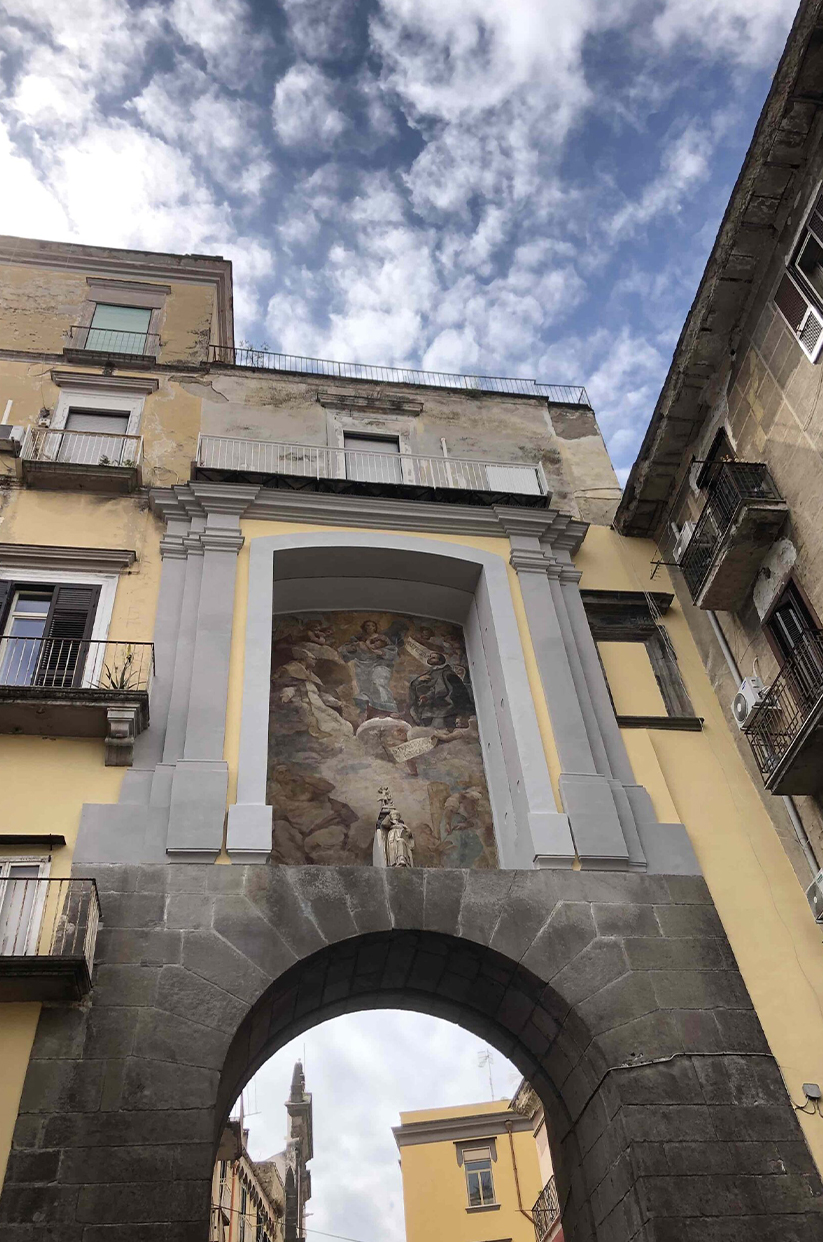
Porta San Gennaro, set facing the Borgo dei Vergini, is one of the oldest of the city’s gates. Recorded in the sources as early as 928, it was demolished and rebuilt a first time in the ducal era and a second time in 1537, during the Spanish viceroyalty, at the behest of Don Pedro di Toledo. The gate was dedicated to San Gennaro because it was an obligatory passage on the way to the catacombs of the patron saint.
In 1656, at the end of an extremely violent outbreak of plague, the Consiglio degli Eletti of Naples decreed that votive images be painted above all the city gates in thanksgiving for having escaped the peril of the pestilence. The execution of the works was entrusted to Mattia Preti, who had established himself in those years as one of the leading painters on the city’s artistic scene. Of the seven frescoes for the seven Neapolitan gates, that of Porta San Gennaro is the only one to survive, and it stands as an important testimony to our knowledge of Preti’s pictorial output, whose work was fundamental for many Neapolitan artists and for the birth of Neapolitan Baroque painting.
The fresco depicts the Immaculate Virgin with the Child in her arms, flanked by San Gennaro, San Francesco Saverio and Santa Rosalia, who intercede for the end of the disease.
The scene is divided into two registers: in the upper one, the Virgin and Child amid a glory of Angels rests on a crescent moon, a typical iconographic attribute of the Immaculate Conception. On one side San Gennaro, in episcopal vestments, holds the ampoule of blood in his hands, while on the other San Francesco Saverio points his finger towards the cartouche bearing the inscription: S. FRANCISCUS XAVE… PATRONUS. Placed in the background, in monastic habit, is Santa Rosalia, crowned by a garland of roses.
The lower part of the fresco portrays the misfortunes suffered by the inhabitants of the plague-stricken city. On the left, though by now almost illegible, the Allegory of the Plague sits on the steps, depicted as a woman covered in sores and clothed in rags, caught in the act of biting herself, a symbol of the disease that feeds upon itself through contagion.
The conservation history of the fresco appears deeply troubled: twenty years after the creation of the votive aedicule, the painting was damaged by the terrible earthquake of 1688 and, by the mid-eighteenth century, it lay in a very poor state of conservation. At the end of the nineteenth century it was decided to restore it, covering it with a compound of egg white and whey which, combining with airborne particulate matter, rendered it almost entirely illegible.
The most recent restoration dates back to the 1990s, but today the precious work, which had become degraded and blackened through the effect of polluting atmospheric agents and the lack of maintenance, has been brought back entirely to new light.
Timeline
Completed
Survey, analysis, intervention and final documentation.
 Fundraising goal
€ 30,000
Fundraising goal
€ 30,000
Budget dedicated to the conservation and enhancement of the work.
 Work status
Completed
Work status
Completed
Intervention completed and returned to the city.
Comune di Napoli
AReN – Associazione Restauratori Napoletani · Del Core Restyling