 Timeline
October 2026 – Ongoing
Extraordinary maintenance: removal of invasive vegetation, cleaning of run-off stains and a new lighting system.


Active fundraising · Works in progress
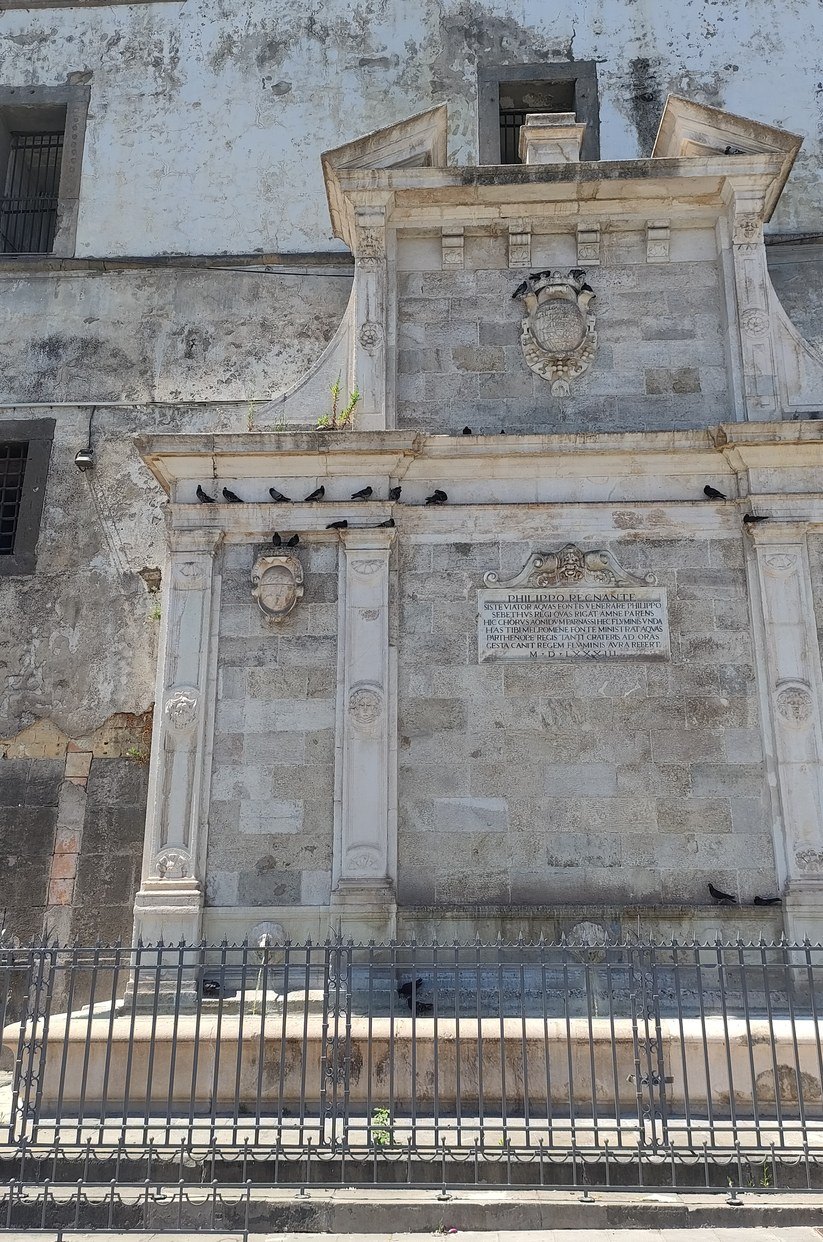
The Fontana del Formiello is located in Piazza Enrico De Nicola, situated behind the 12th-century Norman Castel Capuano and near Porta Capuana, once an important 15th-century eastern gateway into the walled city of Naples. In the past the fountain served as a strategic refreshment point for travellers and citizens, as well as a watering trough for animals. Its name derives from the Latin ad formis meaning “towards the conduits”, a reference to the channels of the Bolla aqueduct that carried water from the Sebeto River into the city.
The monumental structure, built from volcanic stone, dates back to 1573, when the Neapolitan Water Tribunal (Tribunale delle Acque) commissioned Mastro Joseppe and Michel De Guido to replace an existing, disused medieval fountain. A restoration was later commissioned in 1582 by the Viceroy Pedro Téllez-Girón, Duke of Osuna and, in 1583, a dedicatory inscription was added which reads:
“Pause, O traveller, to revere the waters of this spring—fed by the river of Father Sebeto—under the reign of Philip. Here, the chorus of the Aonides [the Muses] and the waters of the Parnassian stream are offered to you by Melpomene. Parthenope, amidst the breezes of her gulf, bears witness to such a great king. Year 1583.”
The fountain is constructed on two levels. The lower level features a basin, fed by water flowing from three lion-headed masks. Above the basin, centred between the first tier of pilasters, is the aforementioned inscription commissioned by the Viceroy. The pilasters are adorned with refined, low-relief carvings: four medallions depicting two male and two female faces, representing the four seasons. The upper level of the fountain bears the viceroy’s coat of arms and terminates in a broken pediment. At its centre one can still see the pedestal upon which Viceroy Don Pedro Antonio d’Aragona had once placed a statue of King Philip IV which was subsequently removed.
Towards the end of the 19th century the fountain was dismantled and placed in municipal storage. It was later reconstructed in 1930 on the eastern side of Castel Capuano, where it was enclosed by a protective iron railing, the appearance it retains to this day.
The new project involves major maintenance and enhancement work, including the removal of invasive biological growth and mineral stains caused by water runoff, as well as the installation of a new lighting system designed to highlight the fountain at night.
Timeline
October 2026 – Ongoing
Extraordinary maintenance: removal of invasive vegetation, cleaning of run-off stains and a new lighting system.
 Fundraising goal
€ 40,000
Total cost of the extraordinary maintenance and enhancement works on the fountain.
 Work status
Active fundraising
Works in progress: you can contribute to the completion of the intervention with a donation, also through Art Bonus.
Comune di Napoli · ABC Napoli
Dafne Restauri