 Timeline
Restoration completed
Timeline
Restoration completed
Survey, analysis, intervention and final documentation.


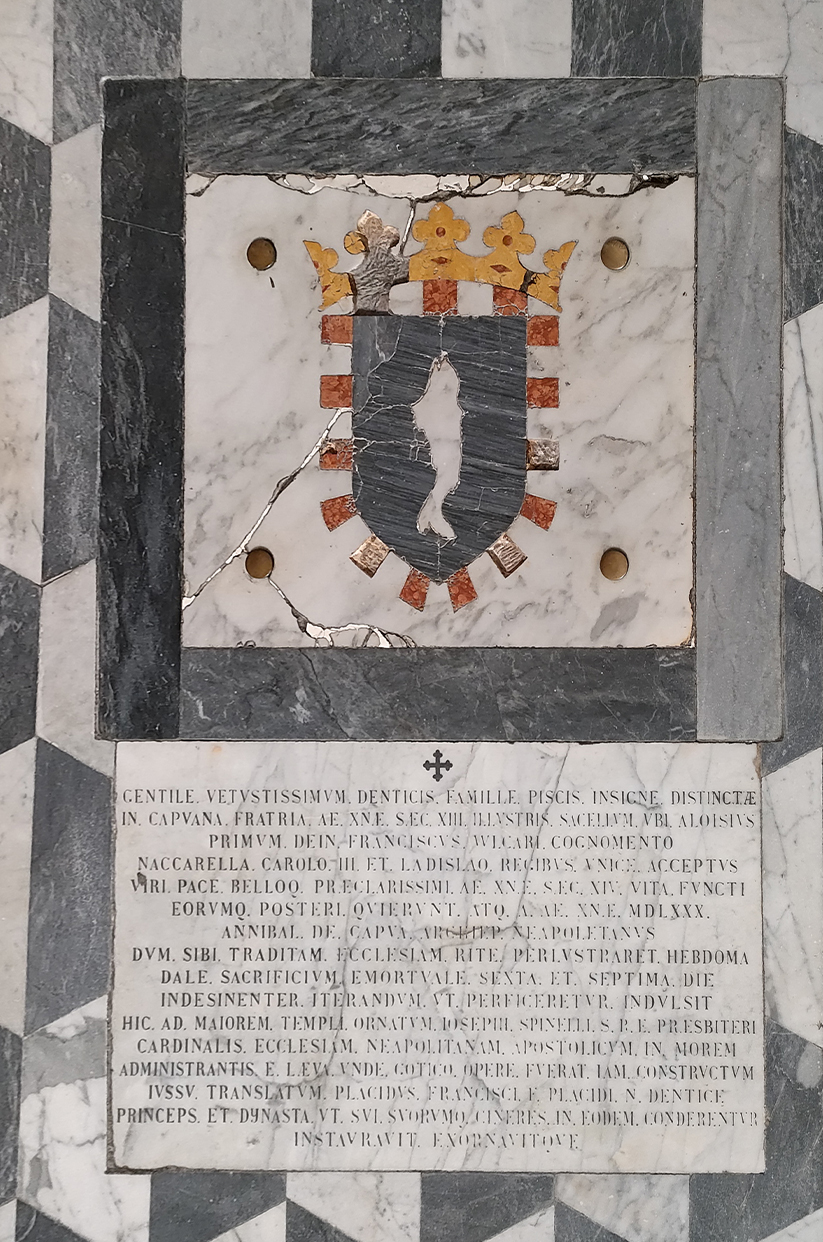
Inside the Cathedral, before the Sacristy, lies the tomb slab of the Dentice del Pesce family, made in the eighteenth century by Neapolitan craftsmen.
A direct examination identified elements of white Carrara marble, bardiglio, and red and yellow Verona marble.
The memorial stone is realised according to the technique of execution and decoration of marble inlay. The small polychrome stone slabs were shaped in various forms to create the overall geometric design. Each element, or crusta, is bedded, following the traditional technique, onto the mother slab with a paste composed of colophony and a carbonate aggregate.
The floor memorial stone is composed of two parts, an upper one bearing the family coat of arms, and a lower one with an epigraph that reads:
GENTILE. VETUSTISSIMUM. DENTICIS. FAMIL. PISCIS INSIGNE. DISTINCTAE
IN CAPUANA. FRATRIA. AE. XNAE. SAEC. XIII. ILLUSTRIS
SACELLUM. UBI. ALOISIUS. PRIMUM. DEIN
FRANCISCUS. VULGARI. COGNOMENTO. NACCARELLA
CAROLO. III. ET LADISLAO. REGIBUS. UNICE. ACCEPTUS
VIRI. PACE. BELLOQ. PRAECLARISSIMI
AE. XNAE. SAEC. XIV. VITA. FUNCTI
EORUMQ POSTERI. QUIERUNT. ATQ. A. AE. XNAE. MDLXXX
ANNIBAL. DE. CAPUA. ARCHIEP NEAPOLETANUS (sic)
DUM. SIBI TRADITAM. ECCLESIAM
RITE PERLUSTRARET. HEBDOMADALE
SACRIFICIUM. EMORTUALE. SEXTA. ET. SEPTIMA. DIE
INDESINENTER. ITERANDUM. UT. PERFICERETUR. INDULSIT
HIC. AD. MAIOREM. TEMPLI ORNATUM
IOSEPHI SPINELLI. S. R. E. PRAESBITERI CARDINALIS
ECCLESIAM. NEAPOLITANAM. APOSTOLICUM. IN. MOREM
ADMINISTRANTIS. E LAEVA UNDE. GOTICO. OPERE
FUERAT. IAM. CONSTRUCTUM. IUSSU. TRANSLATUM
PLACIDUS. FRANCISCI F. PLACIDI N. DENTICE
PRINCEPS. ET. DYNASTA. UT. SUI. SUORUMQ. CINERES
IN. EODEM. CONDERENTUR. INSTAURAVIT
EXORNAVITQUE.
The memorial stone once stood before the chapel of the Dentice family, dedicated to the Annunziata, which was suppressed during the restoration of the Cathedral promoted by Cardinal Filippo Giudice Caracciolo, Archbishop of Naples between 1833-44.
The work, returned to its original decorative richness, was restored thanks to the direct contribution of the family.
Timeline
Restoration completed
Survey, analysis, intervention and final documentation.
 Fundraising goal
€ 2,000
Fundraising goal
€ 2,000
Budget dedicated to the conservation and enhancement of the work.
 Work status
Completed
Work status
Completed
Intervention completed and returned to the city.
L’Officina Restauro · Russo Marmi